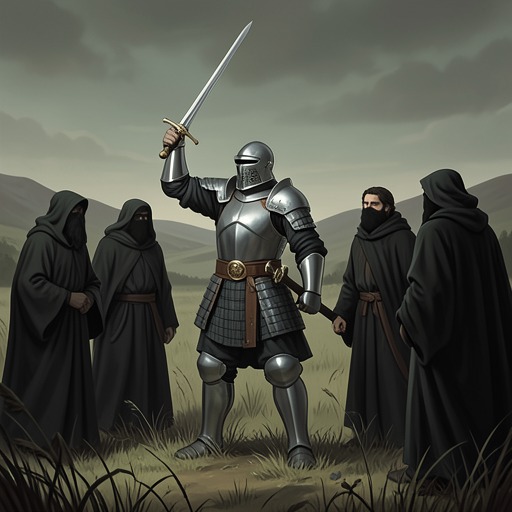
Spiritual temptation
Le Morte d'ArthurSpiritual temptation is a recurring test in the Grail narrative: it confronts knights with apparent rewards, urgent appeals to pity, and misleading religious signs, then measures their choices against Christian duty. In Sir Bors’s trials, temptation takes the form of visions and a devil’s deception, and an abbot interprets those experiences as a struggle over discernment, chastity, and service to the Church. The concept belongs to the wider meaning of the Sangreal, whose history and appearances place the quest within a Christian account of sin, faith, and redemption.
The Grail’s Christian Framework
The Sangreal is introduced as the object of a quest central to Malory’s book. Its name can mean a dish, drinking vessel, or tureen; older descriptions vary between a shallow vessel for food and a cup. The legend also has a pre-Christian aspect: the Grail is traced to a miraculously food-producing vessel. In Malory’s Christian frame, however, it becomes the dish associated with the paschal lamb at the Last Supper, the vessel in which Joseph of Arimathea received Jesus’s blood, or the sacramental cup itself.
The accompanying account says Joseph took the dish from the house where the Supper had been eaten, received blood from Jesus’s wounds in it, and brought it to England, where it helped convert heathens. A tower was built at Corbenicy to keep it. This sacred history gives the quest a theological direction: its marvels are not merely prizes for prowess, but signs connected to Christ, the Church, and spiritual life. At the Pentecost feast, the hidden vessel passes through the hall; although no one can see who bears it, each knight receives the food and drink he most loves. Its abundance makes the Grail’s wonder tangible, while its sudden disappearance leaves the knights with a mystery rather than possession.
That movement from outward marvel to inward interpretation is also visible in the story’s ceremonial episodes. At Camelot on Whitsunday, gold letters identify the appointed seats at the Round Table, and new writing on the Siege Perilous declares that its time has arrived. Sir Launcelot calculates the date from the Passion and recognizes that the Pentecost feast falls in the appointed year. The court covers the inscription while waiting for the one destined to achieve the adventure. The episode makes the quest legible as a matter of prophecy and spiritual qualification, not simply a contest among knights.
Bors’s Visions and the Problem of Discernment
Sir Bors’s test begins in sleep, where images present him with competing interpretations of goodness. A white bird offers the riches of the world and promises to make him as fair and white as itself; a smaller black bird claims that its blackness is more valuable than the other bird’s whiteness. In another vision, a worm-eaten chair stands on one side of a chapel, while two lily-like flowers appear on the other. One flower seems poised to take the other’s whiteness, but a good man separates them; many flowers and abundant fruit then grow from them. The dream poses a choice between preserving a decaying structure and protecting the flowers, but its symbols are not self-explanatory.
The next day, Bors is asked to fight on behalf of a lady whose lands had been given to her by King Aniause. Her opponent says the lady has wronged her, and the dispute is to be settled by a battle between their knights, with the winner’s side receiving the land. Before fighting, Bors refuses a meal until the battle is done, invoking God’s grace. The combat therefore follows a spiritual vision into a practical test: he must act amid competing claims, rather than treating every appeal or image as a reliable guide.
A priest later explains part of the dream. The white bird, he says, signifies a fair and wealthy woman who loves Bors; the great bird foretells that he will refuse her, and the priest warns that this choice will lead people to regard him as responsible for the deaths of his brother Sir Lionel and his cousin Sir Launcelot. The interpretation presses Bors to exchange the pursuit of worldly praise for a different obligation. When the priest leads him to a high tower, richly dressed ladies welcome and entertain him, and a beautiful lady is presented as the one who desires his love. The scene translates the white bird’s offer into luxury and erotic temptation, while the warning makes the apparent choice carry the weight of his kin’s lives and of his own reputation.
The Devil’s Deception and the Abbot’s Reading
Bors refuses the woman’s request, saying that his brother has only recently been slain. She declares that she has loved him for his beauty and courage and appeals to him to grant her love. When he will not, she goes up to a high battlement with twelve gentlewomen. One of them begs him to relent, warning that the women will fall from the tower and that ladies will condemn him as dishonorable if he lets them die. Bors feels pity at their apparent danger, but does not yield. The women then fall, and the tower, ladies, and chapel vanish. He blesses himself, hears a great cry, and recognizes that the scene was a deception; he gives thanks to God for escaping it and rides on.
At an abbey, the abbot identifies Bors as a fellow of the Sangreal quest and interprets the visions through Christian teaching. The bleeding great bird, whose blood revives its young, signifies Christ’s suffering and the Grail. The barren tree represents the world without fruit unless it comes from God. The disputed lands and the ladies’ conflict signify the new law of Jesus Christ and the Church at war with the old law and the devil; Bors’s battle is consequently understood as the defense of the Church. The black bird represents the Church, while the white bird represents the fiend. The abbot also warns that outward whiteness can conceal inward sin: the swan’s fair exterior becomes an image of hypocrisy that deceives the world.
The abbot identifies the apparent religious counselor who misled Bors as the devil in disguise. The false counselor directs him toward what seems to be his brother’s death and blames him for leaving Lionel, but the abbot says Lionel is still alive. In his interpretation, the deception was meant to make Bors despair and turn toward vain hope and lechery, preventing him from finding the Grail’s blessed adventure. The abbot reads the two flowers as maidens whom Bors protected from sexual sin, and the rotten tree as Lionel, whom he calls a murderer and a failure of the knightly order. The moral is not that a knight should ignore suffering, but that apparent urgency and outward holiness can be manipulated; discernment must be judged by the spiritual consequences of the choice.
Temptation as a Measure of the Quest
Bors’s episode distinguishes spiritual service from the appearance of virtue. The white bird’s promised riches and beauty, the tower’s hospitality, the lady’s appeal, and the false counselor’s religious dress each offer an attractive or authoritative surface. Their meanings shift as the priest and abbot interpret them, and the abbot’s account explicitly exposes the counselor as a deceiver. Spiritual steadiness therefore depends not on accepting every visible sign, but on testing what it demands and what its consequences would be.
The episode also makes the Grail quest a trial of competing duties. Bors is told that saving a woman’s honor may cost him the opportunity to save his brother and cousin; the deception then exploits his compassion by staging apparent deaths. The abbot’s interpretation reverses the pressure: Lionel remains alive, and Bors’s defense of the women accords with his role as a servant of Christ. The narrative does not present the images as a simple code before the fact; their spiritual significance is clarified through counsel after the trials have unsettled his judgment.
The quest’s wider structure reinforces this movement from wonder to revelation. At a later Grail episode, Joseph appears before Galahad and his companions with four angels, and a bleeding spear is set beside the vessel. During the mass, a figure resembling a child enters the bread; afterward, a figure bearing the signs of Christ’s Passion emerges from the vessel and gives the knights the sacred food. The scene connects the Grail’s material signs with Christian sacrament and Christ’s presence. Beside Bors’s deceptive visions, it clarifies the stakes of spiritual discernment: the quest distinguishes counterfeit appearances from sacred revelation, and worldly reward from the spiritual life the Grail promises.